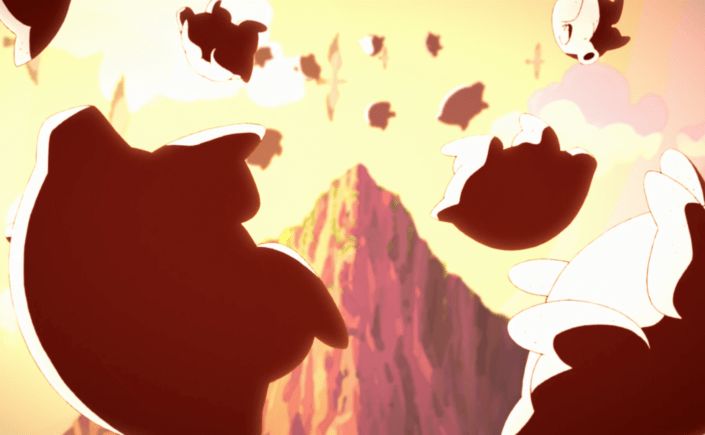
Short Review — Koutetsujou no Kabaneri: A Beautiful, Emotional Trainwreck

Synopsis: Koutetsujou no Kabaneri is an anime-original series that shows how the initially weak-willed protagonist, Ikoma, grows as a character while fighting off hordes of zombies from attacking his friends and other villagers aboard the Iron Fortress, a steam-powered locomotive.

This is the type of story that everyone wanted after the Attack on Titan craze struck anime fans as something that invoked deep emotions through its characters, but also contained high-powered, well-animated action sequences that made the anime stand out from others. With similar kinds of expectations to meet, Koutetsujou no Kabaneri steamrolled into the scene, attempting to become the next anime to take on that role and to give fans a new incarnation of that same sort of story to live vicariously through. This show, being created by nearly the same core team as Attack on Titan, was automatically seen as a hit among fans across the globe, and with the unique setting and art style, backed up by Hiroyuki Sawano‘s OST, there was no stopping the hype train. But if all of this was the case, then why was there a complete turnaround on the general community’s view of the show? Why has a show that was on a track for nothing but success, suddenly become the bane of nearly everyone that has finished the show?

Continue reading

The Cottage Industry of Indie Game Soundtracks

Not anime related but absolutely worth a read for any fan of games or music. Some of the best and more interesting soundtracks on here.

I’ll be finishing up some posts soon!

Short Review — Tonari no Kaibutsu-kun: An Unsympathetic Love Story

Synopsis: The anime Tonari no Kaibutsu-kun (also known as My Little Monster) is a shoujo manga adaptation about understanding the relationship between Mizutani Shizuku, a hardworking student, and Yoshida Haru, a troublemaking delinquent.

As with all shoujo stories, romance and relationship-building are what drives the genre and finding a stand-out from the typical formula of two people meeting and slowly coming to realization of their feelings for each other is a rarity. Tonari no Kaibutsu-kun defies the conventional formula by starting out with the confession and working backwards. Because of this, we get to watch these characters handle romantic issues in a highly genre-breaking fashion. Shizuku and Haru struggle with each other and themselves to discover their own feelings for each other and what the concept of love truly means to them. While this likely isn’t the first instance of a shoujo story breaking the genre, genre-breakers are always interesting and are especially easy to draw people into watching.

Continue reading

Chickens Don’t Make Good World Leaders: Why the Fairies Can Replace Humankind in Humanity Has Declined

If you have watched Episode 10 of the Log Time Podcast, or have any semblance of familiarity with the series Jinrui wa Suitai Shimashita (also referred to as Jintai) you’re more than likely familiar with the Fairies, the pint-sized figures of great power and importance within Jintai. Considered in some regards to be mythological, the Fairies are very real, very present, and admittedly, very goofy forces of nature. As humanity slowly plods on towards its seemingly inevitable demise, the Fairies have been considered by some, namely Watashi and her Grandfather, to be the “new humanity.” They are humanoid, capable of the creation and utilization of advanced tools, even magic, and are generally an amiable species. It seems that for these reasons and others that the Fairies have been conceptually considered to be the theoretical successors of mankind on earth. Considering them humankind’s successors brings up other questions, namely that of the reason behind mankind’s stepping down, so to speak. We already get a basic sense of this from the title, roughly “Humanity Has Declined.” We understand that humankind is on its way out, as Watashi states, but we are unsure of the specifics of how this decline came about. Watashi alludes towards a decline through frivolity and decadence – through waste and overconsumption. We have causes, but not any specific instances of what brought about the downfall, and as a result, we are left to consider several factors – perhaps the largest of which is “why the Fairies?” Why are they being passed the torch? There’s as many possibilities as there are people with opinions out there (and that’s a bunch), but I’ve picked out three that came to mind and seemed like interesting points to consider. This is not to say that these are the “most valid” or best possibilities, of course. This is more just a collection of thoughts spawning from my question “Why?”

Continue reading

Nerawareta Gakuen – A Film Where Frame of Reference Matters

My methods of choosing what anime I want to watch next are probably abnormal compared to most. Sometimes I become interested in a show by reading a blog post, or sometimes the selection is completely spontaneous and random. Nerawareta Gakuen fell more into the former category for me, as I originally discovered it through a video created by Digibro, an anime blogger/reviewer. While I can’t find the exact video that originally inspired this post, I found another video of his that reflected the same viewpoint.

Continue reading

Nichijou – A Modern Day Looney Tunes

  wallhaven-42829

It’s an often used statement to say that everything that can be invented already has been. To an extent, I feel that this is true.  There’s been a lot of history of mankind to contend against if you want to invent a new idea.  Specifically for creative fields like writing, films, and different forms of media, this can definitely feel like it’s the case, especially these days when we’re getting remakes of remakes all the time from Hollywood and television. (Did we really need another Fantastic Four?  I mean, the first one was alright but that last one was just horrifying.)

However, even if a plot or setting has been done before, that doesn’t mean that we can’t find new and creative ways of working with those ideas.  Iterating or innovating on an idea can be as 474234great a show of genius or craft as creating something entirely new.  A famous example of this is The Lion King, which borrows heavily from Hamlet both in plot and characters, but you’d never hear someone complain that it’s just a rehash of the same thing.  Both Disney’s animated classic and Shakespeare’s wonderful play may share a lot in common but both also are able to stand on their own as great and incredibly entertaining works.

Another great example that not many may know is a film called 10 Things I Hate About You. A story about a boy (Cameron) who wants to date a girl (Bianca) but only can if the girl’s older and “shrewish” sister can also find a date.  So Cameron gets a bad boy of the school to woo the older sister for him and allow Cameron to date Bianca.  The story may sound familiar because 10thingsihateaboutyou-poster1it’s Shakespeare again with the play The Taming of the Shrew, though this time, less misogynistic.  Watching these back-to-back, you can easily see similarities between the two and a lot of borrowing on the part of the former from the latter, but the stories are not the same and the telling of 10 Things gives something new and fresh for the audience to enjoy.  And that’s really the big thing.  It doesn’t necessarily matter if “it’s been done before”, but more so “how a story or idea is being told”.  Which leads me to one of my favorite anime of all time:  Nichijou.

Continue reading

Acknowledgement and Denial in Haganai NEXT

I’m not entirely sure what compelled me to watch the second season of Boku wa Tomodachi ga Sukunai NEXT (popularly shortened to Haganai NEXT). Haganai’s first season was an intriguing invitation into the world of the Neighbors Club at St. Chronica’s Academy, fronted by Kodaka Hasegawa, Sena Kashiwazaki, and Yozora Mikazuki. The show itself has all of the trappings that you would expect of a comedy-harem-school-romance-slice-of-life, and though I can’t say that I disliked the show, I can’t really say I cared much for it, either. I can at least say that, if nothing else, the show crafted a cast of characters that stood out in my mind some time after I had finished watching the season. It is perhaps because of this – that I cared for the characters but not the show itself – that I decided to give the second season a shot.

Unsurprisingly, the second season was largely more of the same – oversexualized high-schoolers, misunderstandings, and a whole lot of Kodaka being his protag self and missing every romantic advance that his female counterparts sent his way. Honestly, the second season’s pacing and timing of jokes was an improvement over the first, yet there were still moments where I found myself wondering “do I really want to keep watching this?” It was not until episode 10, “The Sad-Case King and the Stone-Cold Story” (“Zannen Ō to Waraenai Hanashi” [残念王と笑えない話]), that I stopped asking myself this.

Continue reading

My Personal Favorites of 2015

It sure has been a while folks, but we are back in business in Owningmatt land!

I’ll quickly go over some updates and then we’ll jump straight into the content since I’m sure this is the post that everyone was waiting for after all of this time. If not… well, I guess you’ll have to wait for the next time. Anyway.

Continue reading

Picking up Chicks in Dungeons and Other Ideas About Chivalry

dungeon-ni-deai-wo-motomeru-no-wa-machigatteiru-darou-ka-5532c74b20b9b

A few seasons past, I started a podcast with my incredibly handsome friends Owningmatt and the equally handsome GeneralTofu about anime and, specifically at the time, what all shows we were watching.  If you’ve seen it (which is quite literally one person besides ourselves so congratulations to you, dedicated fan of a very small anime blog), you might have caught a thirty minute discussion (read: accidental rant) surrounding a show that had come out during the spring 2015 season of anime called Dungeon ni Deai wo Motomeru noha Machigatteiru darou ka or otherwise known as Is It Wrong to Try to Pick Up Girls in a Dungeon?  It’s probably an easy guess that this anime was based off of a light novel series with a name that long, and while I haven’t read the source material, the show itself is interesting.

The idea of Dungeon is to take your typical MMORPG anime storyline but make it based in an actual fantasy realm instead of a game.  Inside of this realm, heroes fight dangerous monsters in ever more difficult levels of a dungeon most likely constructed by the same architect behind the Wayside School building (shout out to Scholastic Book Fairs).  As they explore, heroes collect gems that litter the danmachi_1-3different levels. These gems are found inside monsters, with the larger and more powerful gems residing in higher level monsters and more dangerous floors of the dungeon.  The heroes use these as a sort of currency by exchanging them for money and resources that they need to continue to take on more and more difficult challenges.  Heroes are sponsored by various gods and goddesses who form a higher social class and rely on their heroes’ worship and gem collection in order to grow their power.  In exchange, the gods and goddesses give the heroes special powers as well as use their own abilities to assist in the exploration of the dungeon.

The interesting aspects of this show come from the fact that this entire universe is based around the difficult floors of the dungeon that the heroes face.  Currency, sports, jobs, etc. are all centered around either the heroes who go into b8d543d5f281fed58c3f5a9774ecb8bb253a9909_hqthe dungeon or assisting the higher class of gods and goddesses with their daily lives.  Even most of the powers the gods exhibit are centered around helping the heroes, with some gods being legendary armor and weapon smiths and others holding monopolies on wine and food trade.  There are even jobs surrounding support classes for the hero.  Some people are hired to do management and consultation for the heroes, while others are hired to collect gems and hold the different heroes’ items while they fight, sharing a percentage of the profits found.
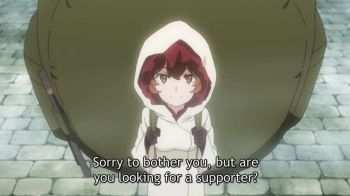
This show had a lot of potential and though it didn’t live up to it, being a bit run-of-the-mill, sans the very elaborate and creative structure of the world and setting, it was a fun ride.  However, the extent of my thirty minute discussion during the podcast was actually not about the plot or setting of Dungeon but on a very central theme that the series explored:  The idea of chivalry.  Specifically, the idea of courtly love that was spawned by chivalry.

Continue reading

Love Live! The School Idol Movie – A Hard-Hitting Punch into Reality

We’ll make everyone’s dreams come true!

Love Live! School Idol Movie Picture 1 - Logo

Note: This will contain some heavy spoilers about the ending of the Love Live! The School Idol Movie. If you haven’t seen the movie before reading this post, then I’d suggest doing so beforehand.

Idol shows are one of those things within the anime community that people either love or absolutely hate. There’s a lot of polarization between fans that like shows with “mature and gritty” stories and those that tend to enjoy milder, “moe” settings. While anime be at all places within that spectrum, idol shows tend to fall on the “moe” side merely because of the character designs and the content discussed, and therefore causes a lot of “tension” (read: shit-posting) between the two fanbases, especially when it comes to the online anime community. Some associate the “moe” side of the spectrum with slice-of-life comedies that have no story or overarching plot; I personally think they’re just missing out.

Continue reading