This week, we talk about Eden of the East and the differing ideologies used within the show on how to solve Japan’s NEET problem.
We also discuss how often we talk about terrorism… Which is apparently a lot more than we thought.
This week, we talk about Eden of the East and the differing ideologies used within the show on how to solve Japan’s NEET problem.
We also discuss how often we talk about terrorism… Which is apparently a lot more than we thought.

Synopsis: The anime Tonari no Kaibutsu-kun (also known as My Little Monster) is a shoujo manga adaptation about understanding the relationship between Mizutani Shizuku, a hardworking student, and Yoshida Haru, a troublemaking delinquent.
As with all shoujo stories, romance and relationship-building are what drives the genre and finding a stand-out from the typical formula of two people meeting and slowly coming to realization of their feelings for each other is a rarity. Tonari no Kaibutsu-kun defies the conventional formula by starting out with the confession and working backwards. Because of this, we get to watch these characters handle romantic issues in a highly genre-breaking fashion. Shizuku and Haru struggle with each other and themselves to discover their own feelings for each other and what the concept of love truly means to them. While this likely isn’t the first instance of a shoujo story breaking the genre, genre-breakers are always interesting and are especially easy to draw people into watching.
Audio Links: iTunes | SoundCloud
This week, we talk about how Jun Maeda affected Charlotte, highlighting the positives and negatives of his writing style along the way.
Our plunge into Maeda was a ride, trust us.
This week we talk about how the characters in Tsuritama deal with anxiety and family issues through a variety of genre-changing scenarios.
Expect lots of bad puns. Lots.
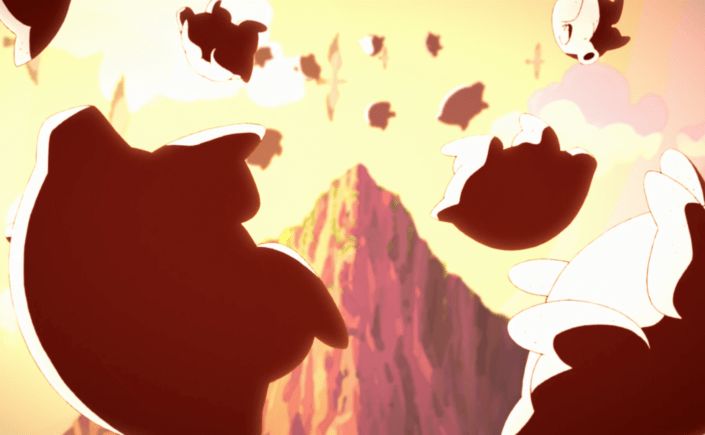
If you have watched Episode 10 of the Log Time Podcast, or have any semblance of familiarity with the series Jinrui wa Suitai Shimashita (also referred to as Jintai) you’re more than likely familiar with the Fairies, the pint-sized figures of great power and importance within Jintai. Considered in some regards to be mythological, the Fairies are very real, very present, and admittedly, very goofy forces of nature. As humanity slowly plods on towards its seemingly inevitable demise, the Fairies have been considered by some, namely Watashi and her Grandfather, to be the “new humanity.” They are humanoid, capable of the creation and utilization of advanced tools, even magic, and are generally an amiable species. It seems that for these reasons and others that the Fairies have been conceptually considered to be the theoretical successors of mankind on earth. Considering them humankind’s successors brings up other questions, namely that of the reason behind mankind’s stepping down, so to speak. We already get a basic sense of this from the title, roughly “Humanity Has Declined.” We understand that humankind is on its way out, as Watashi states, but we are unsure of the specifics of how this decline came about. Watashi alludes towards a decline through frivolity and decadence – through waste and overconsumption. We have causes, but not any specific instances of what brought about the downfall, and as a result, we are left to consider several factors – perhaps the largest of which is “why the Fairies?” Why are they being passed the torch? There’s as many possibilities as there are people with opinions out there (and that’s a bunch), but I’ve picked out three that came to mind and seemed like interesting points to consider. This is not to say that these are the “most valid” or best possibilities, of course. This is more just a collection of thoughts spawning from my question “Why?”
In this episode, we talk about Kyoukai no Kanata and how Kyoto Animation used this anime to push their abilities to the limits.
Also yaoi armpit doujinshi.

My methods of choosing what anime I want to watch next are probably abnormal compared to most. Sometimes I become interested in a show by reading a blog post, or sometimes the selection is completely spontaneous and random. Nerawareta Gakuen fell more into the former category for me, as I originally discovered it through a video created by Digibro, an anime blogger/reviewer. While I can’t find the exact video that originally inspired this post, I found another video of his that reflected the same viewpoint.

It’s an often used statement to say that everything that can be invented already has been. To an extent, I feel that this is true. There’s been a lot of history of mankind to contend against if you want to invent a new idea. Specifically for creative fields like writing, films, and different forms of media, this can definitely feel like it’s the case, especially these days when we’re getting remakes of remakes all the time from Hollywood and television. (Did we really need another Fantastic Four? I mean, the first one was alright but that last one was just horrifying.)
However, even if a plot or setting has been done before, that doesn’t mean that we can’t find new and creative ways of working with those ideas. Iterating or innovating on an idea can be as  great a show of genius or craft as creating something entirely new. A famous example of this is The Lion King, which borrows heavily from Hamlet both in plot and characters, but you’d never hear someone complain that it’s just a rehash of the same thing. Both Disney’s animated classic and Shakespeare’s wonderful play may share a lot in common but both also are able to stand on their own as great and incredibly entertaining works.
Another great example that not many may know is a film called 10 Things I Hate About You. A story about a boy (Cameron) who wants to date a girl (Bianca) but only can if the girl’s older and “shrewish” sister can also find a date. So Cameron gets a bad boy of the school to woo the older sister for him and allow Cameron to date Bianca. The story may sound familiar because  it’s Shakespeare again with the play The Taming of the Shrew, though this time, less misogynistic. Watching these back-to-back, you can easily see similarities between the two and a lot of borrowing on the part of the former from the latter, but the stories are not the same and the telling of 10 Things gives something new and fresh for the audience to enjoy. And that’s really the big thing. It doesn’t necessarily matter if “it’s been done before”, but more so “how a story or idea is being told”. Which leads me to one of my favorite anime of all time: Nichijou.
Log Time is the podcast of The Backloggers where we talk about anime, manga, light novels, and how people become crazy, homicidal killers when they gain the unlimited power of immortality.
In this episode, we go over how Baccano!’s format affected the perception of the show and discuss the wide variety of characterization present within the show, all while providing some comedic humor along the way (the comedic part may be open to interpretation).
Also, I hope we’re getting better. Feel free to contact us if you have any feedback for us or the site!
Articles are also coming soon. Keep an eye out for those!

I’m not entirely sure what compelled me to watch the second season of Boku wa Tomodachi ga Sukunai NEXT (popularly shortened to Haganai NEXT). Haganai’s first season was an intriguing invitation into the world of the Neighbors Club at St. Chronica’s Academy, fronted by Kodaka Hasegawa, Sena Kashiwazaki, and Yozora Mikazuki. The show itself has all of the trappings that you would expect of a comedy-harem-school-romance-slice-of-life, and though I can’t say that I disliked the show, I can’t really say I cared much for it, either. I can at least say that, if nothing else, the show crafted a cast of characters that stood out in my mind some time after I had finished watching the season. It is perhaps because of this – that I cared for the characters but not the show itself – that I decided to give the second season a shot.
Unsurprisingly, the second season was largely more of the same – oversexualized high-schoolers, misunderstandings, and a whole lot of Kodaka being his protag self and missing every romantic advance that his female counterparts sent his way. Honestly, the second season’s pacing and timing of jokes was an improvement over the first, yet there were still moments where I found myself wondering “do I really want to keep watching this?” It was not until episode 10, “The Sad-Case King and the Stone-Cold Story” (“Zannen Ō to Waraenai Hanashi” [残念王と笑えない話]), that I stopped asking myself this.

