Please, Please Don’t Watch W’z

It’s the end of 2018. The year is coming to a close, with a new year and new anime just on the horizon. As I scan over the Winter 2019 season’s offerings, I spy a show called W’z that stirs something within me – it looks a whole lot like Hand Shakers, a show that, no pun intended, shook me to the core almost two years ago. I find a trailer, and sure enough, it’s the same style, aesthetic, and even the jarring gear-looking weapons. I’m having minor heart palpitations. Surely Hand Shakers didn’t get a sequel greenlit – a show that was as consistently panned by critics and viewers alike couldn’t have been given the blessing, let alone the budget, for a season two. I talk to my co-host Owningmatt93, and I’m assured by him that “it’s just the style GoHands does, man. All of their stuff looks like this.” Looking at trailers for, for instance, K: Return of Kings, it does indeed look pretty much exactly the same, aside from a lesser emphasis on a mix of 2D and 3D animation. My fears assuaged somewhat, I continue on with my look at what’s in store for the next few months.

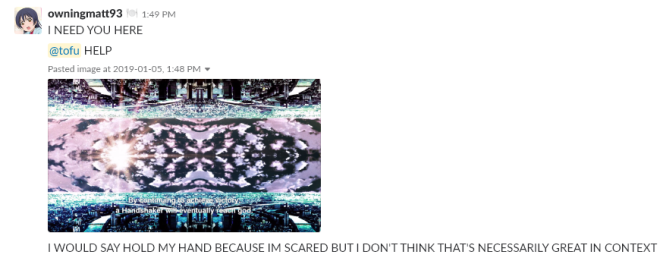
It’s 2019. A new year, a fresh start, and a new season ahead of us for anime. It’s 2019, and I get this message in The Backloggers Slack chat:
shaking

…Wait.

screenshot (61)

…No.

shaking 3

No.

shaking 2

NO.

Continue reading

3D Kanojo 5 + 6 – All Aboard the Misunderstandings Train

Given how it works within the romcom genre of anime, 3D Kanojo is an odd show to begin with. It eschews a number of tropes that make so many of the romantic plotlines in those series feel contrived and samey through how it approaches the awkwardness and insecurities of new romance, and in turn makes its characters feel surprisingly relatable. As we reach the midpoint of the season, however, things seem to have gotten a bit muddied in terms of some of the show’s strong track record out of the gate. While episodes 5 + 6 do have their fair share of heartfelt moments that get to the core of what makes this show so good (in my view), it definitely suffers in terms of a few pretty important story plotlines and character-building moments.

Continue reading

3D Kanojo 3 + 4 – Love, Insecurity, and Other Such Things

3D Kanojo got off to a fascinating start in the first two episodes, giving us some perspective and a view into our awkward, complicated romantic leads Tsutsui and Igarashi. It was a pretty solid foundation, in my opinion, to base the rest of the show off of, and episodes 3 and 4 have both proved to have not dropped the bar of quality that has been set for the show thus far. While the first two episodes acted as a primer of sorts, episodes three and four focus quite heavily on the ways in which insecurities can develop on all sides of a new, burgeoning romance, how they can complicate issues between partners, and ultimately how people can respond to those issues in healthy, trusting ways.

Continue reading

3D Kanojo 1 + 2 – Brick by Brick

3D Kanojo, on the surface, isn’t exactly a show we haven’t seen before. At first glance, it appears to follow the archetypical show/book/etc. formula of “nerdy boy finds love through beautiful girl”, a trope which, obviously, is fairly problematic. But there is far more to this show going on below the surface. From these first two episodes, we find that, in fact, it has so far come to us as a show about harmful misconceptions, and how looking beyond them can lead to genuine, satisfying relationships. While there’s a lot that we could focus on for a discussion of this show, I want us to look specifically at our main characters, Hikari Tsutsui and Iroha Igarashi, and the fascinating, complex spaces that they inhabit.

Continue reading

Violet Evergarden 13 – Letters Written, Burdens Lifted

Violet Evergarden’s final episode is an episode largely of catharsis, and it is one that I, and many others, have wrestled with. In many ways, it brings us to the logical conclusion of the show, or rather to the stopping point for this portion of Violet’s story that we receive. In truth, I have watched this episode numerous times over, mulling its events over in my head, and it has been a process of numerous revisions to how I have come to finally view this last piece of Violet’s story (for now, anyway). Through this, I have found that my thoughts have changed significantly in more recent viewings. This final episode, depending on your reading of events, can be quite clear-cut on the surface, or somewhat more muddied as you dive deeper into it. It does give Violet a great sense of closure, a lifting of burdens, a renewed sense of self and purpose, and a renewed vigor to live her life. But that vigor for a life that she has fought tooth and nail for over the course of this season, again, depending on your reading, can manifest as either a genuine sense of moving on, or it can be somewhat tainted, if it is read as a vigor to live her life for Gilbert; no longer in pursuit of him, but to live life waiting for him, should he be alive. I want to talk about the two as we go forward here, because through my viewings of this final act, I have come to see both.

Continue reading

On Self-Love: Sanrio Boys and Yuru Camp Bucking Societal Norms

The Winter 2018 season was, in many ways, a genuine surprise, primarily so because of the sheer volume of genuinely solid shows that were offered in this first bit of the year. What has surprised me beyond this, however, is that not only did we have a number of shows that I am already seeing as possible contenders for anime of the year, but a number of shows, to my surprise, made some concerted pushes in terms of working to buck some norms (or at least attempting to do so) that are fairly present within the general sphere of seasonal anime. For this season in particular, one theme that stood out to me has been that of self-love/self-acceptance, and this came to me most notably while watching Yuru Camp and Sanrio Boys.

Continue reading

Violet Evergarden 7+8 – In the Grasp of Loss

It is fairly easy to say that, up until this point, Violet Evergarden has been fairly single-minded in its approach to the conveyance of its narrative, plot direction, and character development. Though episodes three through six have very much contained their own interesting, well-detailed vignettes that feel quite distinct from one another, they have invariably followed, to some degree, a formula of sorts for each episode. Through the course of each story, we follow a side character who initially misunderstands Violet, learns more about her, and feels they understand her a bit better by the end of the episode, and during this period of time, Violet comes to understand an emotion that had previously been inaccessible or unknown to her. Beyond that, while there have been a small number of deviations from the standard course of the show thus far, Violet Evergarden has stayed the course in keeping with its low-key, slow-burn delivery of its tale to us. Episodes seven and eight change that.

Continue reading

Violet Evergarden 1+2 – Great Promise, Great Worry

[Disclaimer from the team: While this anime is not out in the United States, currently, a large amount of our followers and fellow Anibloggers are not from the United States and we felt it would be good to share our own thoughts on the series along with them. This is also a bit of a statement for the US branch of Netflix. While we are happy that Netflix is helping to fund and support the anime industry and we fully support legal means for watching anime, their practices in timed region-locking content are not something we agree with, particularly in the case of this show which is available in every country except our own with no explanation as to why. Therefore, given the show in nature is the most anticipated of the past year and we have no available legal means of joining the international discussion, we felt we should write about it regardless.]

Violet Evergarden is finally here. To say that it has been one of the most-hyped anime series to come by in the last few years would be a pretty massive understatement. Whether it’s been through talks about Netflix’s choice of streaming with regards to other countries, discussion from those who have read the source material, or just sheer hype over the potential of the show shown through interviews and PVs, it seems like Violet Evergarden has seeped into conversations for a very, very long time. Does it stand up to the raging hype machine that’s been set up alongside it?

Well, yes…but I’m also a tad concerned.

Continue reading

Just Because! Episodes 9 + 10 – The Windup

In looking back on episodes seven and eight of Just Because!, it genuinely feels as though those episodes were in a way a fairly bubbly (by comparison) reprieve from some of the existential and romantic angst that has come from the show in previous aspects. The focus on Eita’s dedication to Natsume, the admittedly fun date that Komiya dragged Eita into, and Souma’s optimism over his possible future prospects with Morikawa all really gave the last two episodes an easy sense of genuinely not having to worry too entirely much about what the future holds. It is, of course, a naive sort of reprieve, one which comes with some of the youthful and childish kind of optimism that is so easy for us to hold on to. I guess it’s only appropriate, then, that with the episodes nine and ten, “Answers” and “Childhood’s End”, we are brought fully back into the show’s dealings with difficult questions, and some genuinely painful, adult answers.

Continue reading

Just Because! Episodes 7 + 8 – The Things We Do For Love

When I talked about some of the previous episodes of Just Because! serving as the climax for a first act of the show, I feel as though I inadvertently hit the nail on the head with regards to the shifts that episodes seven and eight set in place for what might be the last (or at least most central) major arc for the rest of the show’s season. There’s always been a focus on Eita in the show (and rightly so, considering he is set as the central character of the series from the outset), but for about the first half of the season, I felt as though Eita was mainly just playing a support role, and didn’t seem to have quite as active a role in the major plotlines. We knew, for instance, that Eita was quietly doing his best to pursue Natsume and support her, but we didn’t see anything quite as in-your-face as some of the antics surrounding Souma. The central focuses for the first six or so episodes largely gravitated towards Souma and the sort of love-parallelogram that encompassed him, Natsume, and Morikawa. Now that these threads have been resolved at least to a point, it feels like the stage has been set for us to see Eita’s own tangled web of infatuation sprawl out before us.

And boy, does it ever.

Continue reading